



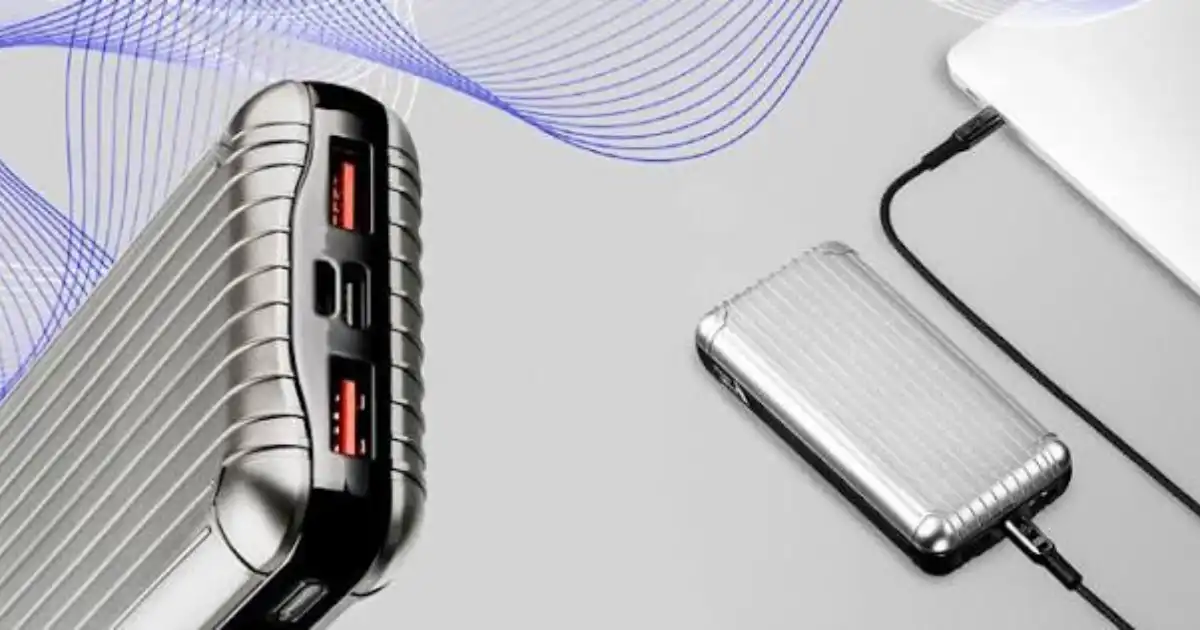
Your phone can be at 10% just when you need it most. Maybe you are traveling, using GPS to find an unfamiliar place, working away from your desk, attending classes all day, or simply stuck somewhere without a wall outlet. This is where a portable charger becomes genuinely useful.
A portable charger extends your device’s usable battery runtime by supplying additional electrical energy from its own internal battery. You connect it to your phone, tablet, or another compatible device, and it transfers stored energy to recharge the device while you continue using it.
The important distinction is that a portable charger does not make your phone’s built-in battery physically larger. It does not permanently increase battery capacity or reverse battery aging. Instead, it gives you access to extra stored energy when you need it, allowing your device to stay operational for longer. Understanding how this process works also explains why a 10,000mAh power bank does not necessarily provide exactly one or two full charges.
What Is a Portable Charger?
A portable charger, often called a power bank or portable battery charger, is essentially a rechargeable battery system that you can carry with you.
Inside the unit are rechargeable battery cells, usually lithium-ion or lithium-polymer cells, along with electronic circuitry that manages how energy enters and leaves the device.
A typical portable charger contains:
- An internal rechargeable battery
- An input port for recharging the power bank
- One or more output ports for charging devices
- Voltage conversion and regulation circuitry
- Power management components
- Safety systems for conditions such as overcurrent, overheating, and short circuits
The basic idea is simple. You charge the power bank when you have access to electricity. Later, when your phone is running low, the power bank becomes your temporary power source.
The terms “portable charger” and “power bank” are commonly used interchangeably. In practical everyday use, both usually refer to the same type of portable battery device.
How Does a Portable Charger Extend Battery Life?
The simplest answer to how does a portable charger work is this: it stores electrical energy in advance and makes that energy available to your device when you are away from an electrical outlet.
The process looks like this:
- You connect the portable charger to a wall charger or another suitable power source.
- The power bank’s internal battery stores electrical energy.
- You disconnect it and carry it with you.
- Your phone’s internal battery begins running low.
- You connect the phone to the power bank with a suitable cable.
- The power bank’s electronics regulate the electrical output.
- Energy travels through the cable into the phone.
- The phone’s charging system uses that energy to recharge its internal battery.
- Your phone gains additional usable runtime.
Imagine your phone reaches 10% battery during a six-hour road trip. You still need GPS, messages, calls, and perhaps a little entertainment. You connect it to a charged power bank, and the phone begins receiving energy.
If the power bank provides enough usable energy, your phone may climb from 10% to 60%, 70%, or higher. You can then continue using the phone for several more hours.
That is how a portable charger extends battery life in practical terms. It does not alter the phone’s battery. It simply gives the phone access to another source of stored energy.
In my experience, this is the easiest way to think about a power bank: it is extra energy you carry separately from the device itself.
How Does a Power Bank Transfer Power to Your Device?
The process is more sophisticated than simply connecting two batteries together.
A simplified energy path looks like this:
Wall outlet → Power bank → Internal battery → Power management circuitry → Cable → Device
When you charge the power bank, electricity is converted into a form that can be stored in its internal battery cells.
When you later connect your phone, the power bank’s circuitry controls the electrical output. The stored energy may need to be converted from the voltage used by the internal battery cells to the voltage required by the connected device.
The phone then has its own charging and battery management system. It determines how much power it can safely accept and controls the charging process.
The type of connection matters too. USB-A and USB-C are common output options, but the physical connector alone does not determine charging performance. Charging protocols also affect how much power compatible devices can negotiate and receive.
For example, USB-C Power Delivery, commonly called USB PD, can support higher power levels than basic USB charging in compatible equipment. However, the phone, cable, and power bank all need to support the appropriate capabilities.
This is why compatibility matters. A power bank can have a high advertised output, but your device may still charge more slowly if it does not support the same charging standard.
How Much Extra Battery Life Can a Portable Charger Provide?
This is where many people misunderstand power bank specifications.
A power bank’s capacity is often advertised in mAh, or milliamp-hours. A 10,000mAh model sounds as though it should provide exactly 10,000mAh to your phone. In reality, it does not work that simply.
The internal battery cells operate at a particular voltage, while USB output and the phone’s battery operate through different electrical stages. Energy must pass through conversion circuitry, and some energy is lost during that process. Heat and charging inefficiencies also reduce the amount that ultimately reaches the phone’s battery.
For example, a rough practical comparison might look like this:
| Power Bank Capacity | Typical Practical Use |
|---|---|
| 5,000mAh | Emergency top-ups and light daily use |
| 10,000mAh | Good balance for most smartphones and regular commuting |
| 20,000mAh | More suitable for extended travel or charging multiple devices |
These are broad categories, not guarantees of a specific number of charges.
A 10,000mAh power bank may not deliver enough usable energy for two complete charges of every smartphone. A phone with a larger battery will naturally require more energy than one with a smaller battery. The power bank’s efficiency, the device’s charging system, heat, and whether you use the phone during charging all affect the final result.
The important point is that power bank capacity describes stored energy indirectly through the battery’s rated capacity, not guaranteed energy delivered to your phone’s battery.
What Determines How Long a Portable Charger Lasts?
Power Bank Capacity
The larger the power bank capacity, the more stored energy it generally has available.
A 5,000mAh power bank is easier to carry but may be intended mainly for emergency charging. A 10,000mAh model is often a practical middle ground. A 20,000mAh unit provides more energy for long trips, tablets, or multiple devices, but it is also heavier and bulkier.
Device Battery Size
Your device’s battery capacity affects how much energy it needs.
A small smartphone may require considerably less energy for a full recharge than a large tablet. This is why the same portable charger can provide different results depending on what you connect to it.
Charging Efficiency
Energy conversion is never perfectly efficient.
Some energy is lost as heat and through the power conversion process between the power bank’s internal battery and your device. The exact efficiency varies between models and charging conditions.
This is one reason the number printed on the power bank should not be treated as guaranteed usable output.
Using Your Device While Charging
If you are playing a demanding game, navigating with GPS, streaming high-resolution video, making a video call, or running a mobile hotspot, your phone is consuming energy while receiving it.
In light use, more of the incoming power may go toward recharging the battery. Under heavy use, some of the incoming power is immediately consumed by the phone’s processor, screen, radios, and other components.
Sometimes you may connect your phone to a power bank and notice that the battery percentage barely moves. That does not necessarily mean the power bank is faulty. Your phone may simply be using energy almost as quickly as it receives it.
Charging Speed and Output Power
Capacity and charging speed are two different things.
Capacity affects how much energy is available.
Output power affects how quickly compatible devices can receive energy.
A large 20,000mAh power bank with low output power may contain plenty of stored energy but charge a compatible phone relatively slowly. A smaller power bank with higher output power may recharge a device faster, although it has less total energy available.
This distinction is especially important when considering power bank charging speed.
Does a Portable Charger Really Increase Your Phone’s Battery Life?
Yes, if by “battery life” you mean how long you can use the phone before you need access to a wall outlet.
No, if you mean increasing the physical capacity of the phone’s internal battery.
These terms are often confused.
-
Usable battery runtime
How long your device remains usable before you need to recharge it.
-
Battery capacity
How much energy the internal battery can store.
-
Battery health
The condition and remaining maximum capacity of the aging battery.
-
Battery lifespan
How long the battery remains useful before degradation becomes significant.
Suppose your phone is at 10%. You connect a power bank and recharge it to 70%. The phone now has considerably more usable runtime, perhaps enough to get through several additional hours of normal use.
But the phone’s internal battery has not become larger. A battery designed to store a particular amount of energy still has that same physical capacity.
What most people misunderstand is that portable charger battery life is really about extending access to energy, not modifying the device’s battery itself.
Can Using a Portable Charger Damage Your Phone Battery?
A quality, compatible portable charger should not normally damage a phone battery simply because you use it regularly.
Modern phones and reputable power banks include charging management systems designed to control power delivery. Depending on the product, safety features may include overcurrent protection, short-circuit protection, temperature monitoring, and other safeguards.
Problems are more likely when you use:
- Poor-quality or counterfeit power banks
- Damaged charging cables
- Physically damaged chargers
- Incompatible or poorly designed equipment
- Devices exposed to excessive heat
Heat deserves particular attention. Charging already produces heat, and intensive phone use can produce additional heat. If the phone and power bank are both exposed to high temperatures, charging may slow down or stop temporarily.
The practical rule is simple: use a reputable charger, a suitable cable, and avoid charging in unusually hot conditions.
Does Fast Charging Make a Portable Charger More Effective?
Fast charging makes a portable charger faster, but it does not automatically give it more total stored energy.
A power bank’s capacity determines approximately how much energy it can store. Its output wattage and charging protocols determine how quickly compatible devices can receive that energy.
USB-C Power Delivery is one common example of a technology that can support faster charging on compatible devices.
However, faster charging can have practical advantages. If your phone is at 15% and you have only 20 minutes before leaving, a higher-output power bank may restore significantly more battery percentage during that short period.
So, if you need speed, check output wattage and charging compatibility. If you need more total charging capacity, look at the power bank’s energy storage.
How to Choose a Portable Charger That Actually Meets Your Needs
Choosing the Right Capacity
For occasional emergencies, a smaller 5,000mAh unit may be enough.
For daily commuting, work, and study, 10,000mAh is often a practical balance between capacity and portability.
For long trips, camping, multiple devices, or situations where outlets are difficult to find, 20,000mAh may make more sense.
The best capacity is not necessarily the largest one. It is the one that gives you enough additional energy without becoming so heavy that you leave it at home.
Checking Output Power
Check the power bank’s output rating and compare it with what your device supports.
A higher wattage can be useful for compatible phones, tablets, and some laptops, but your device determines how much power it can actually accept.
Checking Device Compatibility
A portable charger for a phone may also work with earbuds, cameras, tablets, or other USB-powered devices.
Laptops are more demanding. Make sure the power bank provides the required output and charging standard before relying on it.
Choosing the Right Ports
USB-C is increasingly common and can offer both input and output on many modern power banks.
USB-A remains useful for older cables and accessories. Multiple ports can be convenient if you regularly charge more than one device.
Built-in cables can also reduce what you need to carry, although replaceable cables offer more flexibility if one becomes damaged.
Considering Size and Weight
There is a simple trade-off: more capacity usually means more weight and physical size.
A 20,000mAh power bank may be excellent for travel but unnecessarily bulky for someone who only needs an emergency top-up during a commute.
Looking for Safety Features
Look for reputable products with appropriate safety protections and clear specifications.
A useful decision rule is:
Choose capacity based on how much additional energy you need, output based on how quickly you want to charge, and size based on how much weight you are willing to carry.
How to Use a Portable Charger Efficiently
Fully charge your power bank before a long trip rather than assuming it still has enough energy from the previous outing.
Use a suitable, undamaged cable. A poor cable can affect charging performance and reliability.
Match the power bank to your device. If you need to charge a laptop or high-demand tablet, check the required output rather than assuming every USB power bank will work.
Keep the power bank away from excessive heat, especially inside hot vehicles or direct sunlight.
Recharge it when its remaining capacity becomes low. If you depend on it for emergencies, do not leave it sitting nearly empty for months.
Finally, follow the manufacturer’s charging and storage instructions. Different battery designs and products can have different recommendations.
When Is a Portable Charger Most Useful?
A portable charger is most valuable when your access to a wall outlet is limited or unpredictable.
During travel, it can keep GPS and communication available throughout a long journey. During a commute, it can prevent a dead phone from becoming a genuine inconvenience.
For remote work or studying, a power bank can provide backup energy during an unexpected outage. Outdoor activities, camping, and long days away from buildings are other obvious examples.
It is also useful for heavy phone users. Navigation, video calls, streaming, gaming, and mobile hotspots can drain a phone much faster than ordinary messaging and browsing.
In emergencies, the value becomes even clearer. A charged phone can be important for communication, directions, and accessing essential information.
Can You Charge Multiple Devices With One Portable Charger?
Yes, many power banks can charge multiple devices through multiple output ports.
However, the available power may be shared between connected devices. If the power bank has a limited total output, connecting several devices can reduce the charging speed available to each one.
Capacity matters too. Charging two phones, a tablet, and wireless earbuds will consume stored energy much faster than charging one phone.
If you regularly charge several devices, check both the total capacity and the maximum combined output.
What Is Pass-Through Charging?
Pass-through charging means a power bank can charge a connected device while the power bank itself is being recharged.
It can be convenient when you have only one wall outlet and want to charge several things at once. However, not every power bank supports this feature, and some manufacturers may limit its use or recommend against relying on it regularly.
Check the specific manufacturer’s instructions rather than assuming every model supports pass-through charging.
How to Make Your Portable Charger Last Longer
There are two different meanings of “last longer.”
One means getting more charging sessions from a single charge. The other means extending the power bank’s overall useful lifespan.
To protect the power bank itself:
- Avoid extreme heat and cold where possible.
- Store it according to the manufacturer’s recommendations.
- Use compatible charging equipment.
- Avoid dropping or physically damaging it.
- Keep it away from moisture unless specifically designed for such conditions.
- Do not continue using a unit that becomes swollen or visibly damaged.
A swollen battery is not something to ignore. Stop using it and follow appropriate manufacturer or local disposal guidance.
Good storage and careful handling will generally do more for long-term reliability than trying to squeeze every last percentage point from each charge.
Portable Charger vs. Wall Charger
A portable charger and a wall charger serve different purposes.
A wall charger is the better option when you have reliable access to an electrical outlet. It can provide continuous power without carrying a large battery around.
A portable charger is useful when you need stored energy away from an outlet. It gives you flexibility rather than unlimited power.
In practical terms, they are complementary. I use a wall charger when I am near an outlet and a power bank when I know I will be away from one.
How to Safely Use a Portable Charger
Inspect your portable charger regularly. Do not use it if the casing is damaged, swollen, cracked, unusually hot, or otherwise behaving abnormally.
Use suitable cables and avoid charging in extreme heat. Keep the unit dry unless it is specifically designed for water exposure.
Buy from reputable manufacturers and avoid suspiciously cheap products with unclear specifications. A power bank is a battery containing stored energy, so manufacturing quality matters.
If you plan to travel by air, check the current requirements of your airline and relevant aviation authorities before your trip. Rules can change, particularly regarding battery capacity and where spare batteries must be carried.
You Might Be Interested In
Conclusion
A portable charger extends battery life by extending usable device runtime, not by increasing the physical capacity of the device’s internal battery. It stores electrical energy in its own rechargeable battery and makes that energy available when your phone or another device needs a recharge away from a wall outlet.
The real-world amount of extra runtime depends on power bank capacity, conversion losses, charging efficiency, device usage, and charging speed. A good portable charger should therefore be chosen according to your actual needs, not simply the biggest mAh number on the box.
For the best experience, consider capacity, output power, compatibility, portability, and safety together. The right power bank is simply one that carries enough extra energy for your situation without becoming a burden you never want to carry.
FAQs
Does a portable charger extend battery life?
Yes, a portable charger extends your device’s usable runtime by supplying additional stored energy when the internal battery is running low. For example, if your phone reaches 10% battery while you are traveling, connecting it to a charged power bank can recharge the phone and give you several more hours of use. This is particularly helpful when you are away from a wall outlet or using power-hungry features such as GPS navigation, video calls, streaming, or mobile hotspots.
However, a portable charger does not permanently increase the physical capacity of your phone’s internal battery. It does not turn a 4,000mAh battery into a 5,000mAh battery. Instead, it works as an external source of stored energy that recharges the existing battery, effectively extending the amount of time you can use your device between access to electrical outlets.
How many times can a power bank charge a phone?
The number of times a power bank can charge a phone depends on several factors, including the power bank’s capacity, the phone’s battery size, energy conversion losses, and how much the phone is being used during charging. A 10,000mAh power bank, for example, will not necessarily deliver enough usable energy to provide two complete charges to every smartphone because some energy is lost during voltage conversion and the charging process.
A phone with a smaller battery may receive more complete charges from the same power bank than a phone with a larger battery. Similarly, using your phone for gaming, GPS navigation, streaming, or video calls while it is connected can reduce the amount of energy available for actually increasing the battery percentage. For this reason, it is better to think of a power bank’s capacity as an indication of how much stored energy it has rather than a guarantee of a specific number of full charges.
Does a power bank increase phone battery capacity?
No, a power bank does not increase the physical capacity of your phone’s internal battery. The battery inside your phone remains the same size and has the same maximum energy storage capacity whether or not you use a portable charger. If your phone originally has a 4,500mAh battery, connecting it to a 10,000mAh power bank does not permanently turn the phone’s battery into a larger one.
What a power bank does is provide an additional source of energy that can recharge the phone’s existing battery. If your phone drops to 10% and the power bank brings it back to 70%, you have effectively gained additional usable runtime without changing the phone’s internal battery. This is why a portable charger can extend battery life in everyday terms while having no effect on the phone’s actual battery capacity.
Is it safe to use a portable charger every day?
Yes, using a portable charger every day is generally safe when you use a reputable product that is compatible with your device and follow normal charging practices. Modern phones have their own battery management and charging systems, while quality power banks typically include protections designed to manage issues such as overcurrent, short circuits, and excessive temperature. Regularly charging your phone from a power bank does not automatically damage the battery.
The main concern is the quality and condition of the equipment. Poorly manufactured or counterfeit power banks, damaged charging cables, physical damage, and excessive heat can create unnecessary risks. If you use a reliable portable charger, a suitable cable, and avoid exposing the equipment to extreme temperatures, daily use is generally a practical and safe way to keep your devices powered.
Can a portable charger damage a phone battery?
A quality, compatible portable charger should not normally damage a phone battery when it is used correctly. The charging system in a modern smartphone is designed to regulate how much power the battery receives, while reputable power banks use voltage regulation and other protective circuitry to deliver power within appropriate limits. Using a portable charger regularly is therefore not, by itself, a reason to expect battery damage.
Problems are more likely when using counterfeit or poorly manufactured products, damaged cables, or equipment that becomes excessively hot during charging. Heat can be particularly important because both charging and intensive phone use can generate additional heat. Choosing a reputable power bank, using a suitable cable, keeping the charging setup away from extreme temperatures, and replacing damaged equipment are sensible ways to reduce unnecessary risks to your phone and its battery.
