



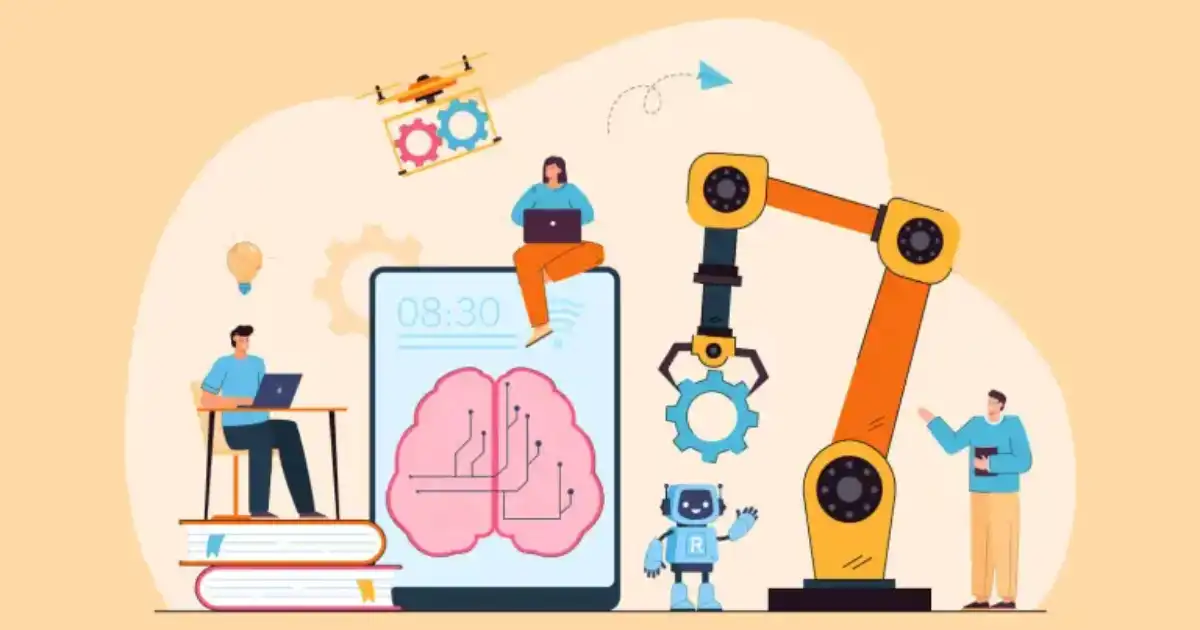
A lot of people still talk about AI like it’s either a magic brain that replaces humans or a dangerous robot waiting to take everyone’s jobs. In real workplaces, it usually looks much less dramatic and much messier.
Most useful AI systems today are not operating alone. They are sitting beside humans, helping with specific parts of the work while people handle everything the machine still struggles with. That distinction matters.
I’ve seen this firsthand in software teams, customer support operations, healthcare workflows, and content production systems. The pattern is surprisingly consistent. AI is very good at speed, repetition, pattern detection, summarization, and generating rough drafts. Humans are still responsible for judgment, context, priorities, ethics, relationships, and dealing with situations that don’t fit neat patterns.
Take a simple customer support example. A company might use AI to answer the first 80 percent of repetitive questions like password resets, delivery tracking, or billing details. Sounds efficient, and it is. But the moment a customer is angry, confused, dealing with an unusual problem, or just needs reassurance, a human usually steps in. Not because the AI is “dumb,” but because real-world situations contain nuance, emotion, ambiguity, and exceptions.
That is what human and AI working together actually looks like in practice. It is rarely full automation. It is collaboration, correction, supervision, acceleration, and constant adjustment.
The interesting part is that the most successful AI systems are often the ones where humans stay deeply involved instead of disappearing from the process.
What Human-AI Collaboration Actually Means
Human-AI collaboration is basically a division of labor.
The AI handles the parts machines are good at. Humans handle the parts humans are still much better at.
That sounds simple, but people misunderstand it constantly. They assume collaboration means AI becoming a co-worker with human-like understanding. In reality, most AI systems are advanced prediction engines. They process huge amounts of information quickly and generate outputs based on patterns. They do not “understand” situations the way humans do.
Where AI Is Strong
AI is excellent at speed. It can scan thousands of medical images faster than a radiologist. It can summarize long documents in seconds. It can analyze transaction patterns across millions of financial records. It does not get tired doing repetitive tasks.
AI is also extremely good at pattern recognition. It notices trends humans may miss because it can compare huge amounts of data at once.
This is why AI in real-world scenarios works well in areas like fraud detection, recommendation systems, logistics optimization, and repetitive workflow automation.
Where Humans Are Still Essential
Humans are better at context, judgment, emotional understanding, ethical decisions, and handling uncertainty.
Humans can recognize when something “feels wrong” even if the data looks fine. We can navigate social situations, conflicting priorities, and incomplete information in ways AI still struggles with badly.
For example, AI helping humans in healthcare works well when doctors use it as diagnostic support. It works badly when organizations expect AI to fully replace medical judgment.
The same thing happens in business operations. AI might identify unusual sales patterns, but a human manager decides whether those patterns actually matter. AI can recommend hiring candidates, but humans still judge personality, communication, team fit, and trustworthiness.
Why AI Alone Often Fails
What most people misunderstand about human-AI collaboration is that AI often performs best when humans actively guide it.
In content creation, AI can generate a decent first draft quickly. But without human direction, the output often becomes generic, repetitive, or factually shaky. A good writer shapes the structure, fixes inaccuracies, adjusts tone, and adds original thinking.
The same pattern appears across industries. AI accelerates parts of the work, but humans provide meaning, direction, and accountability.
There’s also an uncomfortable reality people ignore. AI systems fail in weird ways.
Humans make mistakes too, obviously. But AI mistakes can be strangely confident and surprisingly hard to notice if nobody is paying attention. That’s why human oversight in AI systems matters so much.
In practice, human-AI collaboration works best when the relationship is clear. AI assists. Humans direct, evaluate, and decide.
How Humans and AI Actually Work Together in Practice
The real workflow behind humans and AI working together is usually less glamorous than marketing presentations make it sound.
Most systems follow a fairly predictable pattern.
Step 1: Humans Define the Goal
AI does not create meaningful business objectives on its own.
A business team decides they want faster customer response times. A hospital wants earlier disease detection. A teacher wants help generating personalized exercises. A developer wants to reduce repetitive coding tasks.
Humans decide the purpose. AI operates inside that purpose.
This part matters more than people realize because bad goals create bad AI systems very quickly.
Step 2: Humans Organize the Data
This stage is massively underestimated.
In real projects, bad data ruins AI systems constantly. I’ve seen companies buy expensive AI tools only to realize their internal records are incomplete, outdated, inconsistent, or full of errors.
AI does not magically clean up organizational chaos. If anything, it amplifies it.
For example, if a customer support AI is trained on poor historical responses, it may start repeating bad habits at scale.
Step 3: AI Processes Information
Once the system is configured, AI starts generating outputs.
Depending on the use case, this might include:
- Predictions
- Recommendations
- Chatbot responses
- Summaries
- Generated code
- Risk scores
- Image analysis
- Content drafts
This is the stage most people imagine when they think about AI collaboration examples.
But this is not the end of the workflow.
Step 4: Humans Review the Output
This is where real human-AI collaboration actually happens.
Humans inspect the output for mistakes, missing context, hallucinations, misleading suggestions, or edge cases.
For example, an AI coding assistant may generate functional code quickly, but experienced developers still inspect security risks, scalability issues, architecture decisions, and hidden bugs.
The same thing happens in healthcare. AI systems may flag suspicious areas in medical scans, but doctors still interpret the results using patient history, symptoms, medications, and clinical context.
Step 5: Humans Make Final Decisions
This final authority matters enormously.
AI can recommend. Humans remain accountable.
One reason AI helping humans works reasonably well is because machines handle cognitive heavy lifting that would otherwise consume huge amounts of human time.
Instead of manually scanning thousands of documents, humans review condensed outputs. Instead of writing repetitive boilerplate code, developers refine AI-generated foundations.
Where Things Go Wrong
The better AI becomes at generating plausible outputs, the easier it becomes for humans to stop paying attention carefully.
This is where overreliance starts creeping in.
I’ve seen support agents trust chatbot summaries without verifying details. I’ve seen developers accept AI-generated code too quickly because it “looked right.” I’ve seen managers blindly trust predictive dashboards without questioning assumptions.
AI mistakes are dangerous precisely because they often appear polished.
This is why experienced teams treat AI as an assistant, not an authority.
Good human oversight in AI systems usually includes checkpoints. Humans validate high-risk decisions. Teams audit outputs regularly. Experts monitor patterns. Sensitive tasks require manual approval.
In real operations, the workflow is rarely “AI replaces humans.” It’s usually “AI accelerates part of the process while humans supervise the system and handle complexity.”
Real-World Examples of Humans and AI Working Together
Healthcare
Healthcare is one of the clearest examples of human and AI collaboration.
AI systems are increasingly used to analyze X-rays, MRIs, CT scans, and pathology images. These systems are often very good at spotting patterns associated with tumors, fractures, or early disease indicators.
But the AI is not acting as an independent doctor.
Radiologists still review scans carefully. Doctors still consider patient history, symptoms, medications, and uncertainty. AI may highlight suspicious areas, but humans decide whether those findings matter clinically.
In practice, AI becomes a second set of eyes.
Medicine is full of messy edge cases. Symptoms overlap. Patients describe pain poorly. Data is incomplete. Real-world diagnosis is rarely clean and predictable.
Some healthcare workers also become frustrated with badly implemented AI systems. Certain tools generate too many false positives, creating extra work instead of reducing it.
The useful systems are usually the ones supporting clinicians quietly rather than trying to replace them.
Education
Education is another area where AI collaboration examples become obvious very quickly.
AI tools can generate quizzes, summarize reading materials, create lesson plans, provide language translation, and help students practice skills at their own pace.
Teachers save a huge amount of time on repetitive administrative tasks.
But teaching is not just information delivery.
A student struggling emotionally, losing confidence, or misunderstanding concepts cannot simply be “optimized” by software.
Good teachers constantly read body language, motivation, confusion, and emotional signals. AI still struggles badly with this kind of human awareness.
I’ve seen teachers use AI effectively for support materials while still treating classroom interaction itself as deeply human work.
Interestingly, AI has also forced schools to rethink assessment methods. Many educators now rely more heavily on discussions, presentations, and live reasoning exercises because AI-generated homework is becoming harder to distinguish from genuine student work.
Customer Service
Customer service is probably where ordinary people interact with AI most often.
Chatbots now handle massive volumes of repetitive requests like password resets, appointment scheduling, delivery tracking, and account management.
Operationally, this makes sense. Customers get faster responses, companies reduce costs, and human staff focus on more difficult problems.
But real customer service problems are often emotional rather than technical.
A customer whose package is delayed may not just want information. They may want reassurance. Someone dealing with a billing issue may already be frustrated before the conversation even begins.
AI still struggles with emotional nuance, sarcasm, unusual phrasing, and complicated situations involving multiple systems.
That’s why most support operations still escalate difficult conversations to human agents.
The best systems are hybrid systems. AI handles repetitive workflows efficiently. Humans handle exceptions, empathy, negotiation, and judgment calls.
Content Creation
Content creation is one of the messiest and most misunderstood examples of humans and AI working together.
Writers use AI for brainstorming, outlining, summarizing research, generating first drafts, improving SEO structure, and rewriting awkward sections.
Marketing teams use AI for campaign variations, social media ideas, ad copy drafts, and audience analysis.
But raw AI output often has obvious weaknesses.
It tends to sound generic. It repeats ideas. It lacks lived experience. It confidently invents facts. It struggles with originality because it predicts patterns from existing material.
Human editors shape the final result.
They inject personality, insight, humor, strategy, narrative structure, and audience awareness. They verify claims. They decide what’s actually worth saying.
I’ve seen companies publish unedited AI content at scale. After the novelty wears off, readers usually notice the lack of genuine perspective very quickly.
AI speeds up production. Humans still determine quality.
Software Development
Software development is one of the strongest examples of AI helping humans productively.
AI coding assistants can autocomplete functions, generate boilerplate code, explain syntax, convert code between languages, and help developers debug common problems.
This genuinely improves productivity.
But generating code is not the same thing as designing systems.
Experienced developers still handle architecture, scalability planning, security reviews, testing strategies, debugging complex failures, and long-term maintainability.
AI-generated code can also introduce subtle issues. Sometimes it invents nonexistent functions. Sometimes it creates insecure patterns. Sometimes it generates code that technically works but becomes impossible to maintain later.
Junior developers often trust AI suggestions too quickly because the output looks polished. Senior developers tend to use AI more cautiously, almost like a fast but unreliable assistant.
Manufacturing and Robotics
Factories have used automation for decades, but collaborative robotics has changed how humans and machines share workspaces.
Robots handle repetitive physical tasks like lifting, sorting, assembly, welding, or packaging. Humans supervise operations, troubleshoot failures, maintain equipment, and manage unusual situations.
What’s interesting is that fully autonomous factories are still relatively rare outside tightly controlled environments.
Real manufacturing is messy. Machines jam. Materials vary. Sensors fail. Unexpected situations happen constantly.
Human workers adapt far better to unpredictable conditions.
In many factories, the goal is not eliminating humans entirely. It’s reducing physical strain, improving consistency, and increasing production speed while keeping human supervision active.
Finance
Financial institutions use AI heavily for fraud detection, trading support, customer monitoring, and risk analysis.
AI is extremely good at spotting unusual transaction patterns across massive datasets. It can detect suspicious behavior far faster than human analysts manually reviewing records.
But fraud systems still require human investigators.
Otherwise you get ridiculous situations where legitimate transactions are blocked because the algorithm misunderstood behavior patterns.
Humans review alerts, investigate context, and decide whether action is necessary.
This becomes especially important when bias enters the system through flawed historical data.
Transportation
Driving assistance systems are another strong example of human-AI collaboration.
Modern vehicles can help with lane keeping, adaptive cruise control, parking assistance, traffic monitoring, and collision warnings.
These systems reduce workload for drivers and improve safety in many situations.
But humans are still expected to remain attentive.
The problem is that partial automation creates dangerous psychology. Drivers become complacent and assume the system is smarter than it actually is.
This has already contributed to serious accidents.
One reason fully autonomous transportation remains difficult is because real roads contain endless unpredictable variables. Humans are still much better at handling unusual situations.
Benefits of Human-AI Collaboration
When human-AI collaboration works properly, the productivity gains are very real.
Faster Workflows
AI dramatically reduces time spent on repetitive, predictable tasks.
Support agents handle fewer repetitive tickets. Developers spend less time writing boilerplate code. Analysts process large datasets faster. Teachers reduce administrative workload.
The speed improvement is usually the first thing teams notice.
Better Focus on High-Value Work
The more interesting benefit is cognitive relief.
Humans can focus more energy on strategic thinking, creativity, communication, and difficult decisions while AI handles routine processing.
In software teams, developers spend more time thinking about architecture instead of repetitive syntax. In healthcare, clinicians focus more attention on difficult cases instead of routine screening work.
Improved Consistency
Machines do not get bored performing repetitive checks.
In environments where pattern detection matters, AI can genuinely improve consistency and reduce certain kinds of human error.
But the benefits are uneven.
AI is excellent at structured tasks with clear patterns. It struggles badly in messy human situations involving ambiguity, ethics, emotions, or incomplete information.
The Hidden Tradeoff
There’s also a hidden cost people rarely mention. AI often shifts work instead of eliminating it completely.
Content generation becomes faster, but editing and verification become more important. Automated systems reduce repetitive labor but increase the need for oversight, monitoring, auditing, and quality control.
Some companies discover this the hard way. They automate aggressively, remove too much human involvement, then spend months cleaning up errors the system created.
The strongest results usually happen when organizations treat AI as augmentation rather than replacement.
Challenges and Problems Most People Ignore
One of the biggest misconceptions about AI is that it becomes safer as it becomes more advanced.
In reality, more sophisticated AI often becomes more convincing while still being wrong.
AI Hallucinations
AI hallucinations are a serious issue.
Systems confidently generate false information, fake citations, invented statistics, incorrect legal advice, nonexistent code functions, or misleading summaries.
The problem is not just the error itself. The problem is how believable the error sounds.
I’ve seen teams gradually trust AI-generated reports simply because the formatting looked professional.
Bias and Unfair Decisions
AI systems learn from historical data, and historical data contains human bias everywhere.
Hiring systems, lending systems, predictive policing systems, and recommendation engines can reinforce unfair patterns without anyone explicitly programming discrimination into them.
This becomes especially dangerous when organizations treat AI outputs as objective truth.
Automation Overreach
Some companies become obsessed with replacing human labor and push AI into situations where it performs badly.
You see this in customer service constantly. Businesses replace experienced support staff with rigid chatbot systems that frustrate customers and damage trust.
Bad automation often creates more problems than it solves.
Privacy and Data Risks
Many AI systems require enormous amounts of data to function effectively.
Organizations sometimes collect more user information than people realize. Employees also paste confidential material into AI tools without fully understanding security risks.
This creates growing concerns around privacy, data handling, and compliance.
Lack of Transparency
Modern AI models can be surprisingly difficult to interpret.
Sometimes systems produce useful predictions without clear explanations for why those predictions were made. That becomes uncomfortable in high-stakes environments like healthcare, law, insurance, or finance.
This is one reason human oversight in AI systems matters so much.
Human supervision is not just about catching errors. It’s about accountability, ethics, context, and understanding consequences.
Skills Humans Still Need in the AI Era
One strange effect of AI is that human skills become even more important in areas machines struggle with.
Critical Thinking
Critical thinking matters more now because AI can generate plausible nonsense extremely quickly.
People who cannot evaluate information carefully become vulnerable to polished but inaccurate outputs.
Communication
Communication remains deeply valuable.
AI may generate drafts, but humans still explain ideas clearly, persuade others, navigate disagreements, and build trust.
Those are fundamentally human activities.
Creativity
Creativity still matters, although not exactly the way people expected.
AI can remix patterns rapidly, but genuinely original thinking often still comes from human experience, observation, frustration, curiosity, and emotional understanding.
The best work usually comes from humans using AI as a tool rather than outsourcing all thinking to it.
Adaptability
Workflows are changing constantly.
People who learn how to collaborate with AI tools effectively often become dramatically more productive than people who ignore them entirely.
Judgment
Judgment may be the most underrated skill of all.
Someone still has to decide when AI output is useful, when it is misleading, when exceptions matter, and when human intervention becomes necessary.
That decision-making layer is incredibly important.
The Future of Humans and AI Working Together
The future of AI and humans probably looks less like robot replacement and more like deeply integrated assistance.
AI Copilots Everywhere
We are already moving toward AI copilots inside everyday software.
Writing tools suggest edits automatically. Coding assistants generate functions in real time. Business platforms summarize meetings and draft reports. Medical systems prioritize cases for clinicians.
AI is slowly becoming part of normal workflows rather than existing as a separate “AI product.”
More Human Oversight, Not Less
As AI systems influence more decisions, organizations will likely need stronger verification processes and accountability structures.
Human oversight in AI will become more important as automation expands.
Ironically, smarter AI may increase the need for careful human supervision because mistakes become harder to notice.
Demand for Human Interaction
I also think we’ll see resistance to fully automated experiences in certain industries.
People still want human doctors during difficult diagnoses. They want human teachers during emotional struggles. They want human support during stressful situations.
In many cases, AI will probably make human expertise more valuable by increasing expectations around speed and quality.
Collaboration Will Matter More Than Replacement
The most successful organizations will likely be the ones that combine machine efficiency with human judgment effectively.
Not the ones trying to remove humans completely.
Because after watching these systems evolve in real workplaces, one thing becomes obvious very quickly. AI is powerful, but context is everything. And context is still where humans dominate.
You Might Be Interested In
- How To Use Wombo Ai On Pc?
- How Does Identity Access Management Improve Security?
- What An Ai Pdf Reader Can Do For You?
- Is Autonomous Vehicle Related To Ai?
- How Do I Start Working On Machine Learning?
Conclusion
The reality of human-AI collaboration is much more practical than the hype suggests. In most real environments, AI works best as an accelerator, assistant, filter, or support system. It handles speed, repetition, and large-scale pattern processing extremely well. Humans still provide direction, interpretation, accountability, emotional understanding, and judgment. That balance is what makes the system useful.
What people often miss is that the hardest part is not building AI. The hard part is designing workflows where humans and AI actually complement each other instead of creating confusion, overreliance, or bad decisions. The future is probably not humans versus AI. It’s humans working with AI while constantly deciding where automation helps and where human thinking still matters more. And honestly, that line is going to keep moving for a long time.
FAQs
What is human-AI collaboration?
Human-AI collaboration is the process where humans and artificial intelligence systems work together to complete tasks more efficiently, accurately, and quickly. Instead of AI operating completely independently, the technology usually supports human work by automating repetitive tasks, analyzing large amounts of data, generating suggestions, or improving workflow speed. Humans remain involved in setting goals, reviewing outputs, making decisions, and handling situations that require creativity, emotional intelligence, or contextual understanding.
In real-world scenarios, human-AI collaboration is already deeply integrated into industries like healthcare, education, software development, customer service, finance, and manufacturing. For example, doctors use AI diagnostic systems to help detect diseases faster, while developers use AI coding assistants to speed up software creation. The important thing is that AI does not usually replace the human expert. Instead, it acts like an advanced assistant that improves productivity while humans continue providing oversight, judgment, and accountability. This is why collaborative AI systems are becoming more common than fully autonomous systems.
Can AI replace humans completely?
In most real-world environments, AI cannot completely replace humans because many jobs involve human qualities that machines still struggle to replicate. AI is excellent at processing data, identifying patterns, automating repetitive tasks, and generating outputs quickly, but it lacks true emotional understanding, ethical reasoning, social awareness, creativity rooted in lived experience, and the ability to handle highly unpredictable situations naturally.
What usually happens in practice is not full replacement but workflow transformation. AI changes how people work rather than eliminating humans entirely. For example, content writers may use AI for drafting and brainstorming, but humans still refine the tone, storytelling, originality, and strategy. In healthcare, AI may help analyze medical scans, but doctors still make final decisions using patient history, symptoms, and clinical judgment. Even in highly automated industries, humans remain essential for supervision, troubleshooting, communication, and complex decision-making. The future of AI and humans is much more likely to involve collaboration than complete automation without people.
Why is human oversight important in AI systems?
Human oversight in AI systems is extremely important because AI models can make mistakes that appear convincing and professional. AI systems sometimes generate hallucinations, biased outputs, inaccurate recommendations, or flawed decisions while sounding completely confident. Without human supervision, these errors can spread quickly and create serious operational, financial, legal, or ethical problems.
This becomes especially critical in high-stakes industries such as healthcare, finance, transportation, law, and cybersecurity. For example, an AI system may incorrectly flag a financial transaction as fraud, misinterpret a medical scan, or generate inaccurate legal information. Humans are needed to verify outputs, understand context, identify unusual situations, and make responsible final decisions. Human oversight also helps organizations maintain accountability because AI itself cannot take responsibility for mistakes or ethical consequences. In practice, the strongest AI workflows are usually “human in the loop” systems where people continuously monitor and guide the technology instead of trusting automation blindly.
What are some real examples of humans and AI working together?
There are many practical examples of humans and AI working together across modern industries. In healthcare, AI-powered systems help radiologists analyze X-rays, CT scans, and MRIs faster by identifying suspicious patterns that may indicate disease. However, doctors still interpret the results, evaluate patient history, and make the final diagnosis. In education, teachers use AI tools to generate quizzes, summarize lessons, and personalize learning materials while still managing classroom interaction and student emotional needs.
In customer service, AI chatbots handle repetitive requests like password resets, order tracking, and appointment scheduling, while human agents manage emotionally sensitive or unusual situations. In software development, programmers use AI coding assistants to generate functions, debug code, and automate repetitive tasks, but experienced engineers still handle architecture, scalability, and security decisions.
Manufacturing environments also use collaborative robots that perform repetitive physical labor while humans supervise operations and solve unexpected problems. These human and AI collaboration examples show that AI works best when paired with human judgment and supervision rather than operating completely alone.
What skills do humans still need in the AI era?
Human skills are becoming even more important as AI systems become integrated into workplaces and daily operations. Critical thinking is one of the most valuable skills because people need to evaluate AI-generated outputs carefully instead of assuming the technology is always correct. AI can generate polished but inaccurate information, so humans must analyze recommendations, identify errors, and make informed decisions.
Creativity, communication, emotional intelligence, adaptability, and judgment also remain highly valuable. AI can automate repetitive tasks and generate ideas quickly, but humans still excel at storytelling, leadership, empathy, negotiation, relationship-building, and handling complex social situations.
Adaptability matters because workflows continue changing as AI tools evolve. People who learn how to collaborate effectively with AI systems often become more productive than those who avoid using them entirely. In reality, the AI era is not eliminating human value. It is shifting human value toward higher-level thinking, oversight, strategy, and decision-making.
