



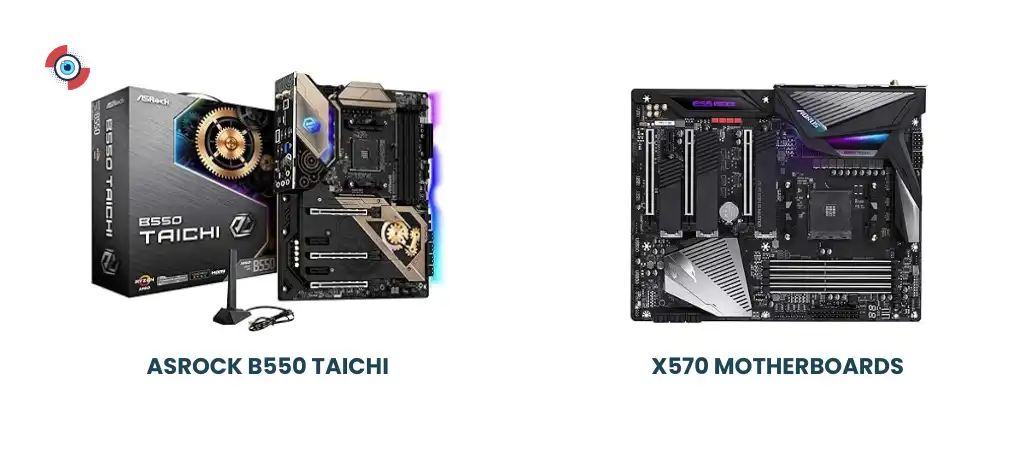
When choosing a motherboard for your new AMD Ryzen build, two popular choices are the Asrock B550 Taichi and the X570. Both motherboards offer high-end features, but they cater to different needs and budgets. Understanding the differences between these two can help you make an informed decision for your PC build.
This comprehensive guide will explore the key distinctions, features, and specifications of the Asrock B550 Taichi and X570 motherboards, highlighting why they are considered the Best Motherboard For Gaming.

Asrock B550 Taichi
The Asrock B550 Taichi is a mid-range motherboard that offers premium features at a more affordable price compared to X570 boards. It is designed to support AMD Ryzen 3000 and 5000 series processors. The B550 chipset is positioned between the entry-level B450 and the high-end X570, providing a balanced mix of features and performance.
Key Features of Asrock B550 Taichi
- Socket: AM4
- Chipset: B550
- Memory: Supports up to 128GB DDR4, with speeds up to 4733+ MHz (OC)
- PCIe: PCIe 4.0 support for the primary GPU slot and NVMe SSD slot, PCIe 3.0 for other slots
- Storage: 8 SATA III ports, 2 M.2 slots (1 PCIe 4.0, 1 PCIe 3.0)
- Network: Intel Wi-Fi 6, 2.5Gb LAN
- USB: USB 3.2 Gen 2 and Gen 1 ports, including Type-C
- Audio: High-quality audio capacitors and premium Blu-ray audio support
- VRM: Robust 14-phase power design
- Form Factor: ATX
X570 Motherboards
X570 motherboards are designed for enthusiasts and power users who demand the highest performance and the latest features. The X570 chipset supports the latest AMD Ryzen processors and offers full PCIe 4.0 support for both GPU and NVMe storage, making it ideal for high-performance builds.
Key Features of X570 Motherboards
- Socket: AM4
- Chipset: X570
- Memory: Supports up to 128GB DDR4, with speeds up to 5000+ MHz (OC)
- PCIe: Full PCIe 4.0 support for all slots
- Storage: Multiple SATA III ports, multiple M.2 slots with PCIe 4.0 support
- Network: Wi-Fi 6, 2.5Gb or higher LAN
- USB: Multiple USB 3.2 Gen 2 and Gen 1 ports, including Type-C
- Audio: Premium audio solutions with advanced codecs
- VRM: High-quality VRM design for overclocking
- Form Factor: ATX, E-ATX
Detailed Comparison: Asrock B550 Taichi vs X570
Chipset and Performance
The primary difference between the Asrock B550 Taichi and X570 motherboards lies in their chipsets. The B550 Taichi uses the B550 chipset, while the X570 motherboards use the X570 chipset. This distinction affects several aspects of performance and capabilities.
-
PCIe Support
- The B550 Taichi supports PCIe 4.0 only on the primary GPU slot and the primary M.2 slot. Other slots are limited to PCIe 3.0.
- X570 motherboards offer full PCIe 4.0 support on all slots, providing higher bandwidth and better performance for multiple GPUs and storage devices.
-
Overclocking Potential:
- Both the B550 Taichi and X570 motherboards support overclocking, but the X570 typically offers more robust power delivery systems, making it more suitable for extreme overclocking.
-
VRM Design
- The Asrock B550 Taichi features a 14-phase power design, which is excellent for stable power delivery and moderate overclocking.
- X570 motherboards often have more advanced VRM designs, with higher phase counts and better cooling solutions, catering to enthusiasts who push their systems to the limit.
Memory Support
Both motherboards support up to 128GB of DDR4 RAM, but there are differences in the memory speeds they support.
-
Asrock B550 Taichi
Supports RAM speeds up to 4733+ MHz (OC).
-
X570 Motherboards
Typically support higher RAM speeds, up to 5000+ MHz (OC), depending on the specific model.
Higher memory speeds can improve performance in memory-intensive applications and gaming.
Storage Options
Storage options are another area where these motherboards differ.
-
Asrock B550 Taichi
- 8 SATA III ports.
- 2 M.2 slots (1 PCIe 4.0, 1 PCIe 3.0).
-
X570 Motherboards
- Multiple SATA III ports (typically 6-8).
- More M.2 slots with full PCIe 4.0 support, often 2-3 slots depending on the model.
The additional M.2 slots and full PCIe 4.0 support on the X570 motherboards make them more suitable for builds requiring extensive high-speed storage.
Network and Connectivity
Both motherboards offer excellent network and connectivity options, but there are some differences.
-
Asrock B550 Taichi
- Intel Wi-Fi 6.
- 2.5Gb LAN.
-
X570 Motherboards
- Wi-Fi 6 or higher.
- 2.5Gb or higher LAN, with some models offering 10Gb LAN.
The X570 motherboards often provide better network capabilities, which can be beneficial for high-speed internet and local network performance.
USB and Connectivity
Both the B550 Taichi and X570 motherboards offer a range of USB options.
-
Asrock B550 Taichi
- USB 3.2 Gen 2 Type-C and Type-A.
- USB 3.2 Gen 1 Type-A.
-
X570 Motherboards
- Multiple USB 3.2 Gen 2 and Gen 1 ports.
- USB Type-C and often more USB ports overall.
The X570 motherboards typically have a greater number of USB ports and better overall connectivity.
Audio Quality
Both motherboards aim to deliver high-quality audio, but the specifics can vary.
-
Asrock B550 Taichi
- High-quality audio capacitors.
- Premium Blu-ray audio support.
-
X570 Motherboards
- Advanced audio codecs.
- Premium audio solutions, often with better shielding and higher quality components.
X570 motherboards tend to offer superior audio solutions, which can be important for audiophiles and gamers seeking the best sound experience.
You Might Be Interested In
- Is ASUS TUF B550M Good For Gaming?
- What Are The 5 Main Components Of A CPU?
- What Language Are GPUs Written In?
- Is B550 Or X570 Better For Ryzen 5 5600x?
- What Ram Is Compatible With Asus Rog Crosshair Viii Dark Hero?
Conclusion
In conclusion, the Difference Between Asrock B550 Taichi And X570 motherboards boils down to their chipsets, performance capabilities, and targeted user base.
- The Asrock B550 Taichi is an excellent mid-range motherboard that offers premium features such as PCIe 4.0 support on the primary slots, robust VRM design, and good connectivity options. It is ideal for users who want a high-performance motherboard without the premium price tag of X570 boards. This makes it suitable for gamers, content creators, and general users who do not need extensive overclocking or multiple PCIe 4.0 devices.
- X570 motherboards, on the other hand, cater to enthusiasts and power users who demand the best performance and latest features. With full PCIe 4.0 support on all slots, higher RAM speeds, advanced VRM designs, and better overall connectivity and audio solutions, X570 motherboards are perfect for high-end builds. They are ideal for users who need extreme overclocking capabilities, multiple high-speed storage devices, and superior network performance.
Ultimately, the choice between the Asrock B550 Taichi and X570 motherboards depends on your specific needs, budget, and the level of performance you require from your system. Both options offer excellent features and performance, but the X570 stands out for those who want the absolute best in terms of capabilities and future-proofing.
FAQs on the Difference Between Asrock B550 Taichi and X570
What are the main differences between the Asrock B550 Taichi and X570 motherboards?
The main differences between the Asrock B550 Taichi and X570 motherboards primarily revolve around their chipsets and the features they support. The Asrock B550 Taichi uses the B550 chipset, which is designed as a mid-range option that bridges the gap between the entry-level B450 and the high-end X570.
This chipset configuration provides PCIe 4.0 support for the primary GPU slot and the primary M.2 slot, offering high-speed data transfer rates for essential components. However, the remaining PCIe slots on the B550 Taichi are limited to PCIe 3.0, which can affect the performance of additional GPUs or storage devices.
On the other hand, X570 motherboards are equipped with the X570 chipset, which offers full PCIe 4.0 support across all slots. This feature ensures that every PCIe slot, whether used for additional GPUs, high-speed storage, or other expansion cards, benefits from the higher bandwidth and performance of PCIe 4.0.
Additionally, X570 motherboards typically come with more advanced VRM (Voltage Regulator Module) designs, enabling more stable and higher power delivery, which is crucial for overclocking and maintaining system stability under heavy loads.
Moreover, X570 motherboards generally support higher RAM speeds, with some models reaching up to 5000+ MHz (OC). They also offer more M.2 slots with PCIe 4.0 support, advanced network capabilities such as 2.5Gb or 10Gb LAN, and superior audio solutions with high-quality components and shielding. These enhancements make X570 motherboards more suitable for power users, enthusiasts, and professionals who require the best performance and latest features.
Which motherboard is better for gaming, the Asrock B550 Taichi or an X570 model?
When it comes to gaming, both the Asrock B550 Taichi and X570 motherboards offer excellent performance, but the best choice depends on your specific gaming needs and budget. The Asrock B550 Taichi provides robust gaming performance with support for the latest AMD Ryzen processors, PCIe 4.0 for the primary GPU slot, and high-speed memory support. These features ensure smooth gameplay and fast load times for most modern games.
However, if you plan to use multiple GPUs in a CrossFire or SLI configuration, or if you want to future-proof your gaming rig with the latest technologies, an X570 motherboard may be a better option. The full PCIe 4.0 support across all slots on X570 motherboards allows for better performance in multi-GPU setups and provides higher bandwidth for other expansion cards and storage devices.
Additionally, X570 motherboards often come with more advanced VRM designs and cooling solutions, which can enhance system stability and overclocking potential, leading to better overall gaming performance.
Another consideration is connectivity. X570 motherboards typically offer more USB ports, including USB 3.2 Gen 2 and Type-C options, which can be beneficial for connecting gaming peripherals and external storage. The enhanced network capabilities, such as Wi-Fi 6 and 2.5Gb or 10Gb LAN, also provide faster and more reliable internet connections, which can improve online gaming experiences.
Can the Asrock B550 Taichi support overclocking like the X570 motherboards?
Yes, the Asrock B550 Taichi supports overclocking and is equipped with a 14-phase power design, which provides stable power delivery to the CPU and other components. This robust VRM setup allows for moderate overclocking, enabling users to push their Ryzen processors beyond the base clock speeds for improved performance in demanding applications and games.
However, X570 motherboards generally excel in overclocking due to their more advanced VRM designs and better cooling solutions. Many X570 models feature higher phase counts, premium components, and efficient heat dissipation mechanisms, such as larger heatsinks and active cooling. These features ensure more stable power delivery and lower temperatures, which are crucial for achieving higher overclocks and maintaining system stability under heavy loads.
For users who aim to achieve extreme overclocks or who frequently push their systems to the limit, an X570 motherboard is typically the better choice. The advanced power delivery and cooling solutions on X570 motherboards make them more capable of handling the increased power and thermal demands associated with high overclocks.
Additionally, X570 motherboards often come with enhanced BIOS options and software tools for fine-tuning overclocking settings, providing greater control over the performance of the system.
Are there differences in memory support between the Asrock B550 Taichi and X570 motherboards?
Both the Asrock B550 Taichi and X570 motherboards support up to 128GB of DDR4 RAM, which is more than sufficient for most users, including gamers, content creators, and professionals. However, there are differences in the memory speeds they support, which can impact overall system performance, particularly in memory-intensive tasks.
The Asrock B550 Taichi supports RAM speeds up to 4733+ MHz (OC), which provides excellent performance for gaming and other applications. This high-speed memory support ensures that data can be quickly accessed and processed by the CPU, reducing latency and improving the responsiveness of the system.
On the other hand, X570 motherboards typically support even higher RAM speeds, with some models reaching up to 5000+ MHz (OC) or more. The higher memory speeds available on X570 motherboards can enhance performance in tasks that rely heavily on fast memory access, such as video editing, 3D rendering, and certain scientific computations. Additionally, higher memory speeds can provide a slight performance boost in gaming, particularly in titles that are sensitive to memory bandwidth.
The advanced memory support on X570 motherboards is also complemented by more sophisticated memory overclocking features and settings, allowing users to fine-tune their RAM for optimal performance and stability. These features make X570 motherboards a better choice for users who require the highest possible memory performance and who are willing to invest in high-speed RAM modules.
Which motherboard should I choose if I need extensive high-speed storage options?
If you require extensive high-speed storage options, an X570 motherboard is the better choice due to its superior support for multiple M.2 slots with full PCIe 4.0 support. X570 motherboards typically come with 2-3 M.2 slots that all support PCIe 4.0, providing higher bandwidth for NVMe SSDs.
This allows for faster data transfer rates, reduced load times, and improved overall system responsiveness, which is particularly beneficial for tasks that involve large file transfers, video editing, and running multiple virtual machines.
The Asrock B550 Taichi, while offering solid storage options, has some limitations in comparison. It provides 8 SATA III ports and 2 M.2 slots, with only the primary M.2 slot supporting PCIe 4.0 and the secondary slot limited to PCIe 3.0. While this configuration is sufficient for many users and provides excellent performance for the primary storage drive, it may not be adequate for users who need multiple high-speed NVMe SSDs for their workflows.
In addition to the increased number of M.2 slots, X570 motherboards often feature more advanced storage management options, such as RAID support and better integration with software tools for managing storage devices. This makes X570 motherboards ideal for users who require extensive and flexible storage solutions, such as content creators, data analysts, and professionals working with large datasets.
Furthermore, the additional PCIe 4.0 lanes on X570 motherboards allow for the use of high-speed expansion cards, such as dedicated RAID controllers or additional NVMe SSD adapters, without compromising the performance of other connected devices. This flexibility and expandability make X570 motherboards the preferred choice for users who demand the best storage performance and scalability from their systems.
